Fish, carp family
Rudd
- Maximum length
- 62cm
- Maximum weight
- 2.1kg
- Best water temperature
- 14–24 °C
- Water today (3.1 °C)
- Tolerates it, but slowed down
- Fishing districts near where it occurs
- 37

Rudd: the species and fishing rules
About the species Rudd
Length up to62 cmWeight up to2,1 kg
How to recognise it
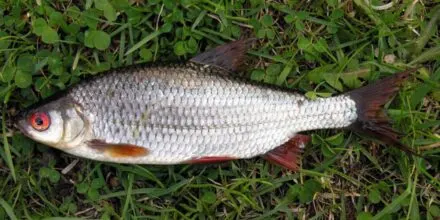
Golden to bronze back, bright red fins and an upper mouth. The dorsal fin starts only behind the start of the pelvic fins, and between the pelvic and anal fins there is a sharp keel, which distinguishes it from the roach.
Where it lives
Overgrown still and slow waters, ponds and oxbows, in shoals just below the surface near plants.
What it feeds on
Algae and aquatic plants, insects from the surface, zooplankton.
Spawning
From April to June; it sticks its eggs to aquatic plants.
It often takes just under the surface, so it is easily caught on float tackle near vegetation. It is easily confused with the roach.
Water, occurrence and catches
Water temperature and requirements
At what temperature the species is active and how well today's water suits it.Best temperature14–24 °CWater today3,1 °C
Tolerates it, but slowed downTypical water in Czechia is 3.1 °C today. The species tolerates this temperature (3 to 30 °C), but the water is colder than the ideal 14 to 24 °C. Fish tend to be slower and pickier.
- tolerates 3 to 30 °C
- best 14 to 24 °C
- spawning at 14 to 20 °C
- typical water today 3.1 °C
- Length
- up to 62 cm
- Weight
- up to 2.1 kg
- Oxygen
- Typical oxygen requirements
- Position in the food chain
- 2.5plants and small animals
The values are indicative and come from the FishBase database. In a particular water, fish behave according to the weather, air pressure, oxygen and food.
Data source: FishBase (Froese & Pauly, Eds.), www.fishbase.se, version 06/2026, licence CC BY-NC.
Where it was recorded
Fishing districts around which a record of this species exists (GBIF).Fishing districts37Basins2
Occurrence by river basin
- Elbe basin23from 1,079
- Danube basin14from 463
Number of fishing districts with a record of the species and the number of all fishing districts in the basin.
By water type
- Non-trout fishing districts3286%
- Trout fishing districts514%
The water type determines the close season and the fishing rules of the fishing district.
Fishing districts with a record
- Dyje 4M
- Morava 18
- Olomoucké Štěrkovny 1 a
- Olomoucké Štěrkovny 1 B
- Ohře 16
- Botič 1
- Vltava 4 (h)
- Dyje 3A
- Vltava 5 (h)
- Berounka 3
- Vltava 6 (h)
- Dračice 1
- Žehrovka 1
- Blata 2
- Botič 2 – údolní nádrž Hostivař
- Litavka 1
- Lužnice 10 a
- Lužnice 10 B
- Oskava 1
- Rybník Libocký
- Šárecký potok 1
- Šárecký potok 2 – údolní nádrž Džbán
- Sitka 1
- Dyje 5A
- Lužnice 11
- Moravská Sázava 4
- Pitkovický potok 1
- Svatava 1
- Svitava 1
- Chomoutov 1 a
- Svinařský potok 1
- Bílina 6
- Suchomastský potok 1
- Labe 24 a
- Labe 24 a – tůně a Pískovny
- Morava 12
37 fishing districts in total, 36 shown. Show on map
Catches of Rudd
Approved catches by anglers on this portal.
Nobody has logged a catch of this species yet. Be the first; once approved it will appear here and on the leaderboard.

In the kitchen and in Europe
Fish in the kitchen
How it tastes, whether it has small bones and how it is cooked.
Flesh
A small, bony fish.
Cooking
- Frying
- Bait
Small ones fried until crisp, more often it is used as bait.
Small bones
Has small bonesTrade names in the EU
The names under which this species is sold in other EU countries.Countries8
- SlovakiaČervenica ostrobruchá
- CzechiaPerlín ostrobřichý
- AustriaRotfederWeißfisch
- Hungaryvörösszárnyú keszegpirosszemű kele
- PolandWzdręgakrasnopiórka
- GermanyRotfederWeißfisch
- RomaniaRoşioară
- ItalyScardola
- Francerotengle
Source: European Commission, commercial designations of fishery and aquaculture products. The names apply when the fish is sold in that country.
Frequently asked questions
Short answers from the data on this page.Questions6
Where does the rudd live?
Overgrown still and slow waters, ponds and oxbows, in shoals just below the surface near plants.
What does the rudd eat?
Algae and aquatic plants, insects from the surface, zooplankton.
When does the rudd spawn?
From April to June; it sticks its eggs to aquatic plants.
What water temperature does the rudd need?
It does best in water at 14 to 24 °C.
Does the rudd have small bones?
It has small Y-shaped bones that are not removed by filleting.
How is the rudd cooked?
Small ones fried until crisp, more often it is used as bait.
Photo credits
- Rudd: Photo: George Chernilevsky, Public domain, Wikimedia Commons
- Roach: Photo: Scardinius_erythropthalmus1_resize.jpg: Original uploader was Algirdas at lt.wikipedia…, CC BY-SA 3.0, Wikimedia Commons
- Silver bream: Photo: author not stated, CC BY-SA 3.0, Wikimedia Commons
Minimum sizes, protection periods and permitted fishing methods are set by the fishing regulations and the conditions of the specific fishing district. Check them before you fish.